

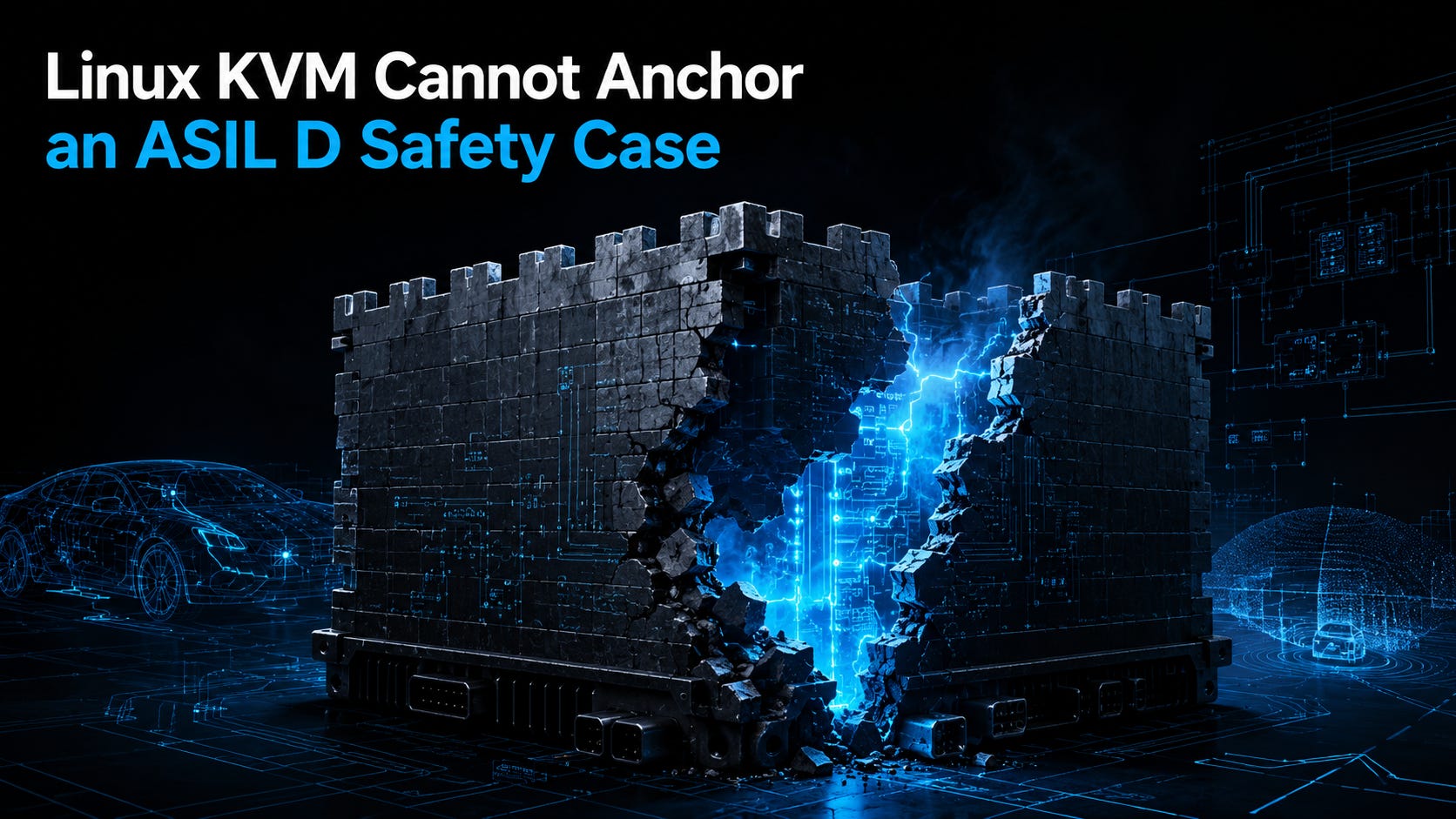
A newly disclosed Linux KVM vulnerability, tracked as CVE-2026-53359 and reported under the name Januscape, lets a malicious guest virtual machine corrupt host kernel memory. The researcher who found it reports that a controlled guest-to-host escape is achievable, not just a crash. For a cloud operations team, that is a serious but familiar kind of event. Patch quickly, restrict the exposed feature, move on.
For a software-defined vehicle team, it is something else entirely. If a hypervisor like KVM sits inside the boundary separating an ASIL D safety function from everything else running on the same compute platform, a guest-to-host escape is not a patching event. It is evidence that the boundary itself cannot be trusted, and no amount of fast remediation changes that underlying fact. The rest of this piece works through why, and what a more defensible architecture actually looks like.
The Bug Behind the Warning
Januscape sits in the shadow MMU path used by KVM’s memory management code on x86 systems, and reporting describes it as a use-after-free issue affecting both Intel and AMD hosts, since the vulnerable code path is shared across KVM’s x86 implementation. Public proof-of-concept code already demonstrates a host crash, and the researcher’s claim of a working escape exploit raises the stakes considerably further. A crash alone would be a reliability problem. An escape is a trust boundary problem, and automotive architects should read those as two very different categories of risk even though they share one CVE number.
The detail that should concern automotive architects most is not the age of the bug. It is where the bug lived. Reporting indicates the path is especially reachable where nested virtualization is exposed, because nested virtualization can force KVM through legacy shadow MMU logic even when hardware-assisted page translation is normally used. That is a rarely exercised, configuration-dependent path, exactly the kind of code a routine safety review is least likely to scrutinize closely, and exactly the kind of code that tends to survive years of otherwise diligent maintenance untouched.
Automotive programs do not consume Linux the way a cloud fleet does. Most pull the kernel and hypervisor components through a curated distribution, often pinned to a specific version for the full lifecycle of a vehicle program, because stability matters more than staying current. That pinning is usually treated as a stability decision. Januscape is a reminder that it is also a security decision, since a pinned kernel does not automatically inherit an upstream fix, and a vulnerability sitting in a rarely touched code path can persist in a shipping vehicle fleet long after the patch already exists elsewhere.
Why Virtualization Became a Safety Question
Virtualization is no longer a convenience layer in modern vehicle architecture. Software-defined vehicles increasingly consolidate workloads that once lived on separate ECUs onto shared high-performance compute platforms. Infotainment, connectivity, diagnostics, ADAS support services, AI workloads, logging, update agents, and safety-related functions may all end up sharing the same silicon, driven by the same cost, weight, and wiring-harness pressures that pushed the industry toward zonal architecture in the first place.
Once that consolidation happens, the hypervisor stops being neutral infrastructure. It becomes part of the safety argument itself, because it is the mechanism deciding what one workload is allowed to do to another. That is a fundamentally different job than the one KVM was built for. Cloud multi-tenancy isolates different customers running roughly comparable workloads. Automotive consolidation isolates workloads of wildly different criticality on the same silicon, where the failure mode of the least trusted workload can be a threat to human life rather than a service-level agreement violation.
Freedom From Interference
Freedom from interference is the concept that allows mixed-criticality software to coexist on shared hardware. A safety-critical function must be protected from corruption, timing disruption, memory interference, resource starvation, or unauthorized influence from lower-criticality software running alongside it. In an ASIL D design, the burden is not to show that interference is unlikely in ordinary use. The burden is to show, with evidence, that the architecture prevents or controls interference to the level the standard requires. Research on automotive mixed-criticality virtualization consistently frames isolation and fault containment as the central certification challenge, not a secondary implementation detail.
Januscape cuts directly through that argument. If a guest can panic the host, availability isolation has failed. If a guest can corrupt host kernel memory, memory isolation has failed. If a guest can potentially execute code on the host, privilege isolation has failed. When the host kernel is responsible for enforcing separation between safety and non-safety domains, the safety boundary has effectively moved from a certifiable separation mechanism into millions of lines of fast-moving general-purpose kernel code, code that nobody on the vehicle program wrote, reviewed line by line, or can realistically freeze.
This is also where ordinary vulnerability management and functional safety diverge. In a typical enterprise risk register, a patched CVE closes the finding. In a safety case built on freedom from interference, the finding closing does not automatically restore the argument, because the argument was never really about this one bug. It was about whether the isolation mechanism as a class can be trusted to hold under conditions nobody has tested yet. Fixing Januscape addresses one instance. It does not address the structural question the instance exposed.
Why Patching Does Not Repair the Safety Case
Patching is necessary, but patching does not repair the safety case by itself. In a certified automotive system, a kernel update is not simply an operational maintenance event. It can require impact analysis, regression testing, updated evidence, and potentially a reassessment of the safety argument that depended on the prior kernel behavior. Suppliers of safety-critical operating systems and hypervisors emphasize the certification burden created by every software modification, precisely because each change can affect a validated safety baseline.
Contrast that with how cloud operators treat a KVM patch. A cloud fleet can roll a kernel update across thousands of hosts in a maintenance window, verify service health, and move on within days. Automotive safety certification was never built around that cadence, and it should not try to adopt it wholesale just because the underlying software came from the cloud world. A vehicle program that treats every KVM security patch as a routine update is quietly accepting an assumption its own safety case never actually earned: that the isolation layer is stable enough not to need re-argued evidence every time it changes.
The Real Certification Trap
Linux KVM has a massive advantage in cloud and enterprise environments because it is flexible, performant, widely tested, and continuously improved. Those are strengths in cloud operations. They become weaknesses the moment the same software sits inside the trusted computing base of an ASIL D system. A safety case wants bounded behavior, small attack surfaces, analyzable interfaces, predictable timing, controlled configuration, and stable evidence. General-purpose KVM was never designed around those constraints. It was designed to support broad virtualization use cases across many CPUs, workloads, devices, memory modes, and performance optimizations, and that breadth is exactly what makes it hard to certify.
Certified separation kernels take the opposite design philosophy on purpose. They favor small, auditable codebases over broad feature support, and they treat every added capability as a cost against certifiability rather than a selling point. That tradeoff looks unattractive on a feature comparison sheet. It looks essential the moment a sixteen-year-old, rarely triggered path in a much larger codebase turns out to be exploitable. The size and feature velocity that make KVM excellent for the cloud are the same properties that make its safety argument nearly impossible to close.
Codebase size is a useful, if blunt, proxy for this difference. A general-purpose Linux kernel with KVM runs into the tens of millions of lines once every driver, subsystem, and architecture-specific path is counted, even though any single vehicle deployment only exercises a fraction of it. Certified separation kernels are built to the opposite target, commonly kept small enough that a dedicated team can plausibly reason about every code path during certification. That gap is not a rounding error. It is close to the entire reason one class of software can produce a defensible safety case and the other struggles to.
None of this means Linux is poorly engineered. It means Linux is optimized for a different goal than certifiability, and the project’s scale and contributor base were never organized around narrowing that footprint. Expecting one piece of software to be simultaneously the most broadly capable hypervisor in the industry and the most narrowly auditable one is asking it to be two different products at once.
A Tokyo Vantage Point
Watching automotive compute strategy from Tokyo across cloud, OEM, and financial infrastructure roles for over three decades, the pattern here is familiar. Japanese OEM and Tier 1 engineering culture has often been criticized for moving slowly on compute consolidation compared to faster-moving software-first entrants elsewhere in the industry. Januscape is a reminder that the caution was never conservatism for its own sake.
It was a rational response to exactly this category of risk, where a component’s cloud pedigree says nothing about its fitness for a certifiable safety boundary. The engineering organizations that insisted on separating safety domains from general-purpose compute long before software-defined vehicle architecture made that separation fashionable were not behind the industry. They were pricing in a risk that the rest of the industry is only now discovering the hard way.
The Layered Answer
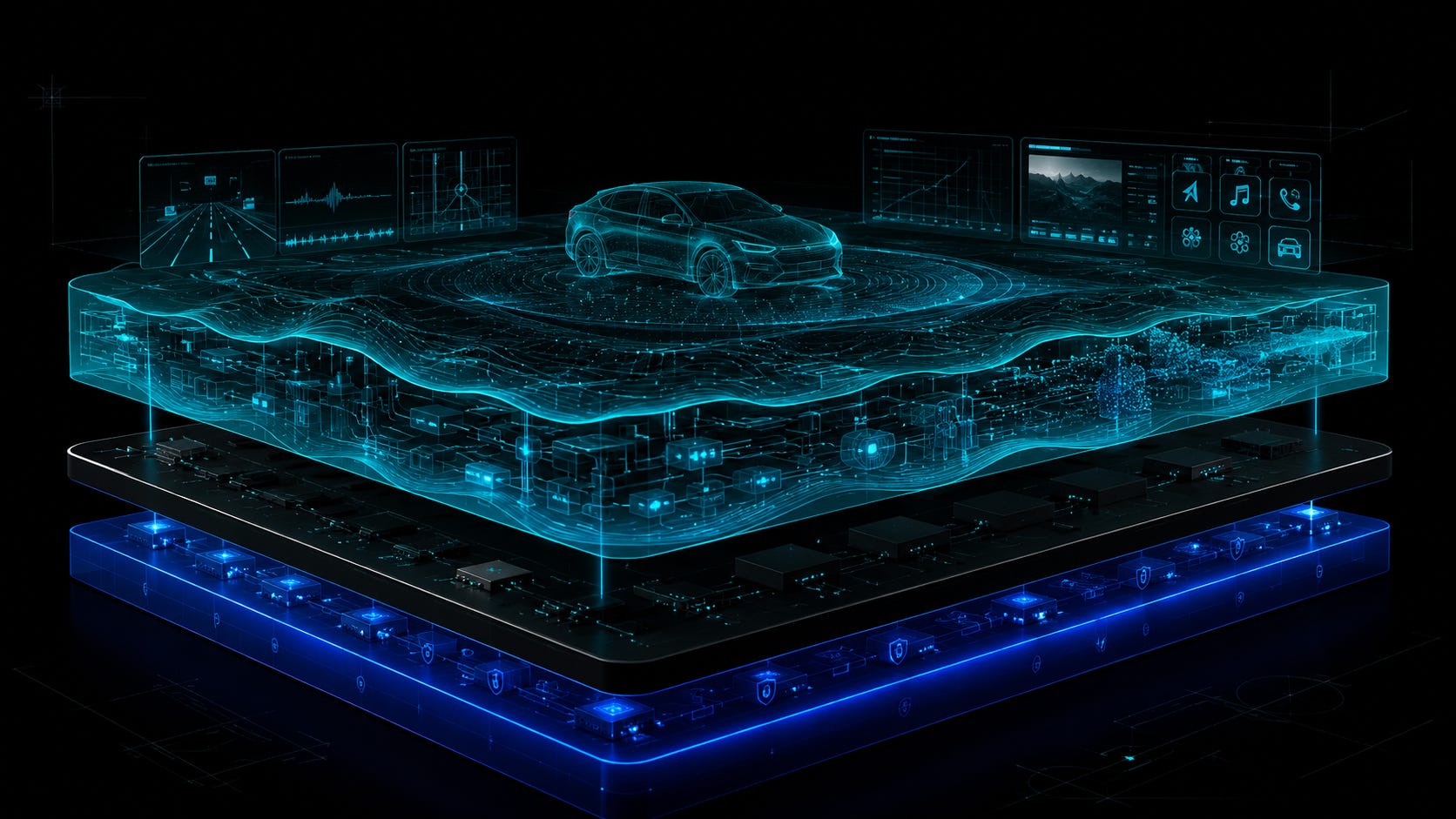
A single guest-to-host escape does not prove KVM can never be used in automotive. It proves that any architecture placing KVM inside the ASIL D trusted boundary faces a very steep evidentiary hill. The more realistic architecture keeps Linux and KVM out of the highest-criticality safety path wherever possible, using a certified or certifiable safety hypervisor, separation kernel, safety island, or lockstep controller to enforce the ASIL D boundary instead.
Linux then runs where Linux is strongest: rich applications, connectivity, AI services, diagnostics, data logging, developer ecosystems, and non-safety orchestration. That is not a demotion of Linux. It is a recognition that different layers of the stack are optimized for different things, and that optimizing for developer velocity and optimizing for a defensible safety argument are not the same design goal, even when they end up sharing the same silicon budget.
The uncomfortable part of this architecture is that it costs something. A dedicated safety controller or a certified separation kernel is more constrained, slower to add features to, and more expensive to maintain than a general-purpose hypervisor with a huge open-source community behind it. Those costs are real. They are also the price of an isolation argument that can actually survive scrutiny from a vehicle safety assessor, which is a price most programs will find easier to pay before an incident than after one.
What Comes Next
The industry consolidating vehicle compute now faces a harder question than which hypervisor performs best. It has to decide which workloads are allowed to sit inside the boundary that protects human safety, and which are not. Januscape does not answer that question. It simply made clear how expensive it is to get wrong, and how little warning an architecture gets before that cost comes due.
All opinions are my own and do not reflect those of my employer.
Please excuse my ignorance, but can a company facing these problems adopt QNX and run what they have in Linux on top. Or, would this involve re-writing everything from scratch?
Well said Sir - I believe there are going to be a lot of tears shed in future by any company that tried to save a few $$$ or allowed an employee to create their own little Linux kingdom based on safety.